Bioinformatics & NGS Sequence Analysis with AI Internship
Build practical skills at the intersection of Bioinformatics, Next-Generation Sequencing, Python, Genomics, Data Analysis and Artificial Intelligence. Work through structured projects designed around modern computational biology and genomic-data workflows.
Why Choose This Internship?
Learn Bioinformatics, NGS & AI Through Practical Work
The Bioinformatics & NGS Sequence Analysis with AI Internship by The Nexora Group is designed for students and early-career learners who want to develop practical skills in computational biology and biological-data analysis.
The curriculum combines Python programming, biological databases, sequence analysis, genomics, NGS concepts, data processing, visualization and AI-assisted computational workflows.
Learn through progressive modules and practical assignments.
Work with sequence and genomics-oriented datasets.
Explore how AI tools can support research and data workflows.
Build project evidence that can be presented in your portfolio.
See What You'll Experience
Watch the internship introduction to understand the learning journey, practical work, projects and overall internship experience.
Ready to Start Your Bioinformatics Journey?
Complete the registration form below to apply for the Bioinformatics & NGS Sequence Analysis with AI Internship.
Secure Your Internship Registration
Application countdown and internship dates update automatically.
Registration Form
Fill in your details below to register for the Bioinformatics & NGS Sequence Analysis with AI Internship.
56 Modules of Bioinformatics, NGS & AI
A structured curriculum covering Python, biological databases, sequence analysis, genomics, NGS workflows, data analysis, machine learning concepts and AI-assisted computational biology.
Introduction to Bioinformatics
Understanding computational biology and biological data.
Computational Biology Fundamentals
Core concepts connecting biology, computing and data.
Python for Bioinformatics
Python programming concepts for biological applications.
Python Data Structures
Lists, dictionaries, sets, tuples and biological data handling.
NumPy for Biological Data
Numerical computing and array-based analysis.
Pandas for Bioinformatics
Tabular biological-data manipulation and analysis.
Biological Databases
Introduction to major biological data resources.
NCBI & Sequence Resources
Working with public sequence resources and databases.
DNA & RNA Sequences
Understanding biological sequence representations.
FASTA Format
Reading, processing and managing sequence files.
FASTQ Format
Understanding sequencing reads and quality information.
Sequence Quality Concepts
Understanding sequencing quality metrics.
NGS Fundamentals
Next-generation sequencing concepts and workflows.
NGS Platforms
Overview of modern sequencing technologies.
Sequencing Read Processing
Preparing sequencing reads for downstream analysis.
Quality Control Workflow
Quality assessment and interpretation.
Read Trimming Concepts
Understanding adapters, low-quality bases and preprocessing.
Sequence Alignment
Principles of aligning biological sequences.
Reference Genomes
Understanding reference-based analysis.
Genome Browsers
Exploring genomic information visually.
BLAST Concepts
Sequence similarity search concepts.
Multiple Sequence Alignment
Comparative analysis of multiple biological sequences.
Phylogenetic Analysis
Understanding evolutionary relationships.
Variant Analysis Concepts
Introduction to genetic variation and variants.
SNP Analysis
Understanding single nucleotide variations.
Genomics Data Processing
Preparing genomic datasets for analysis.
Transcriptomics Introduction
Understanding RNA and expression datasets.
Gene Expression Analysis
Exploring gene-expression data.
Biological Data Visualization
Creating meaningful visual representations.
Matplotlib for Biology
Python-based biological data visualization.
Statistical Concepts
Basic statistics for biological datasets.
Exploratory Data Analysis
Discovering patterns in biological datasets.
Machine Learning Fundamentals
Introduction to machine learning concepts.
ML for Biological Data
Applying machine learning concepts to biology.
Classification Concepts
Understanding biological-data classification.
Clustering Concepts
Grouping biological observations and patterns.
AI in Bioinformatics
Exploring AI applications in computational biology.
Generative AI for Researchers
Using generative AI for research support.
AI-Assisted Literature Review
Organizing and exploring scientific literature.
AI-Assisted Data Interpretation
Using AI tools to support analytical workflows.
Prompt Engineering for Biology
Creating structured prompts for research tasks.
AI Research Workflow
Building repeatable AI-assisted research workflows.
Biological Dataset Project
Practical dataset exploration and analysis.
DNA Sequence Analysis Project
Build a practical DNA sequence analysis workflow.
RNA Sequence Project
Analyze and interpret an RNA-oriented dataset.
NGS Quality Project
Develop a sequencing quality-control workflow.
Sequence Alignment Project
Create a structured sequence alignment workflow.
Genomic Variant Project
Explore a practical variant-analysis dataset.
AI-Based Biological Analysis
Develop an AI-assisted biological data workflow.
Bioinformatics Pipeline
Design an organized computational workflow.
Project Documentation
Document methodology, analysis and findings.
Research Presentation
Present your computational biology findings.
Portfolio Development
Prepare project evidence for your career portfolio.
GitHub Project Documentation
Organize code, documentation and project evidence.
Career Readiness
Prepare your internship work for academic and career use.
Final Capstone Internship Project
Complete and present your final bioinformatics project.
Build Projects You Can Talk About
Apply concepts through structured project work covering biological sequences, NGS data and AI-assisted analysis.
DNA Sequence Analysis
Build a Python-based workflow for processing and analyzing DNA sequences.
NGS Quality Analysis
Explore sequencing-read quality and create a structured preprocessing workflow.
Sequence Alignment
Develop a practical workflow around biological sequence comparison and alignment.
Genomic Variant Analysis
Explore genomic variation through a structured analytical project.
AI-Assisted Biological Data Analysis
Use AI-assisted methods to support interpretation and organization of biological data.
Final Bioinformatics Capstone
Combine Python, sequence analysis, genomics and AI concepts into a final portfolio-oriented project.
More Than Just Learning Modules
Bioinformatics Skills
Develop practical knowledge across sequence analysis, genomics and computational biology.
AI Integration
Explore modern AI-assisted workflows for research, analysis and biological data interpretation.
Python Practice
Work with Python libraries and computational approaches relevant to biological datasets.
Data Analysis
Learn to organize, explore, visualize and interpret biological data.
Project Portfolio
Build project evidence that can strengthen your academic and professional portfolio.
Internship Documentation
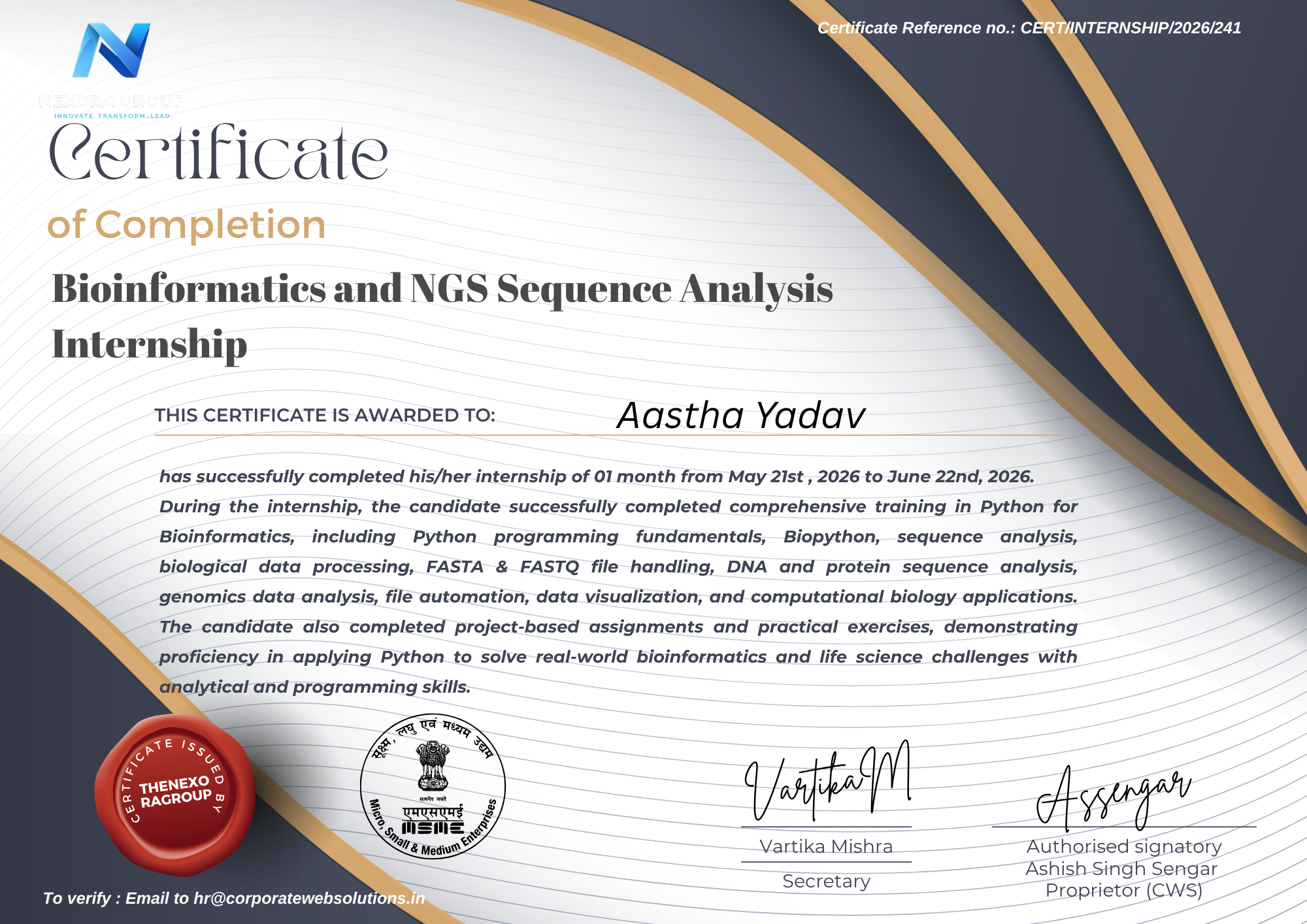
Eligible participants can receive applicable internship completion documentation after fulfilling requirements.
Get Internship Completion Documentation
Successfully complete the applicable internship requirements, assignments and projects to become eligible for the relevant internship completion documentation.
*Applicable documentation is subject to successful completion of the required internship activities and program requirements.
Turn Your Internship Into Career Evidence
Your internship work can help you build a stronger academic, research and career profile when presented with clear project documentation and practical evidence.
Explore Roles Across Bioinformatics & Life Sciences
The skills developed through the internship can support exploration of different academic, research and entry-level technology roles.
What Students Can Say About the Experience
Sample testimonial layout — replace the entries below with verified student reviews before publishing them as factual claims.
“The internship helped me understand how Python can be applied to biological datasets. The sequence-analysis projects made the concepts much easier to understand.”
“I particularly liked the NGS section because it connected sequencing concepts with practical computational workflows. The project work gave me something concrete to discuss.”
“The combination of AI, Python and bioinformatics made the internship interesting. I learned how AI tools can assist research workflows without replacing scientific validation.”
“The structured modules helped me move from basic sequence concepts toward NGS analysis and computational projects.”
“The project-based format was useful because I could document what I worked on instead of only completing theoretical lessons.”
“I wanted exposure to genomics and computational analysis. The internship provided a structured path through Python, sequencing concepts and biological data.”
Questions Students Usually Ask
Who can apply for this internship?
Students, freshers and learners interested in bioinformatics, biotechnology, genomics, computational biology, data science, Python or AI can explore the program.
Do I need previous bioinformatics experience?
Advanced prior experience is not required. The curriculum progresses from foundational concepts toward practical bioinformatics and NGS workflows.
Is the internship online?
Yes. The internship is designed as an online and remote learning experience.
Will I work on projects?
Yes. The curriculum includes practical project work involving biological sequences, NGS concepts, datasets and AI-assisted analysis.
How many modules are included?
The curriculum contains 56 structured modules.
Will I receive a certificate?
Eligible participants who successfully complete the applicable internship requirements can receive relevant internship completion documentation.
Can I add the projects to my portfolio?
Yes. You can organize your eligible project work, documentation and outputs into an academic or professional portfolio.
Does the internship use AI?
Yes. AI concepts and AI-assisted workflows are integrated into selected bioinformatics, research and biological-data activities.
Start Your Bioinformatics & NGS Internship
Applications are processed through the registration form below.
Registration Form
Complete the form to apply for the Bioinformatics & NGS Sequence Analysis with AI Internship.
Ready to Explore Bioinformatics, NGS & AI?
Build practical computational biology skills, work through structured projects and develop portfolio evidence through a focused internship experience.
Enroll for Internship →